


PC上で Echocardiography - Case Study and Review のための互換性のあるAPKをダウンロードしてください
| ダウンロード | 開発者 | 評価 | スコア | 現在のバージョン | アダルトランキング |
|---|---|---|---|---|---|
| ↓ PC用のAPKをダウンロード | WMS, Inc | 1.2 | 12+ |
| SN. | アプリ | ダウンロード | 開発者 |
|---|---|---|---|
| 1. |
 Cardiology Splashcards
|
ダウンロード ↲ | abletFactory |
| 2. |
ECGNote
|
ダウンロード ↲ | daredriven |
| 3. |
Cardiology-Dictionary
|
ダウンロード ↲ | Focus Medica India Pvt Ltd |
| 4. |
ECGinMotion
|
ダウンロード ↲ | cipm GmbH Wessling |
| 5. |
 Awake ECG
|
ダウンロード ↲ | 3fs d.o.o. - Awake |
または、以下の PC (エミュレーター) 用の Echocardiography - Case Study and Review APK をダウンロードしてください。
3 つの簡単な手順で、コンピューターで Echocardiography - Case Study and Review.apk を使用する方法を説明します。
Echocardiography - Case Study and Review iTunes上で
| ダウンロード | 開発者 | 評価 | スコア | 現在のバージョン | アダルトランキング |
|---|---|---|---|---|---|
| ¥1,220 iTunes上で | WMS, Inc | 1.2 | 12+ |
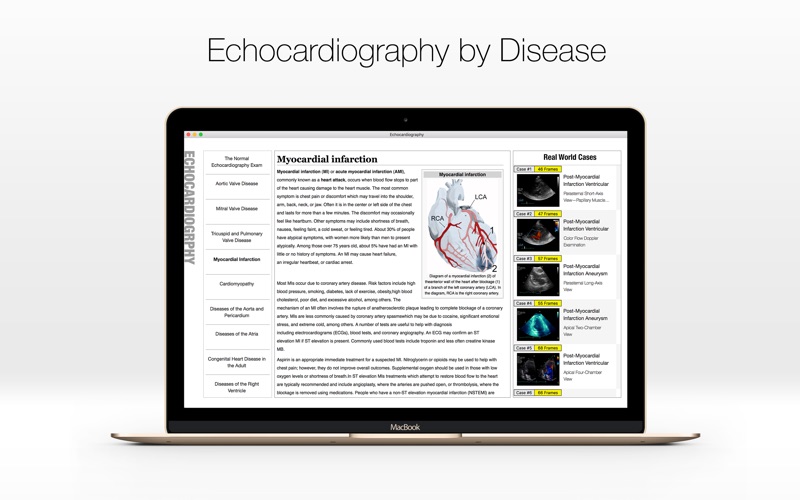
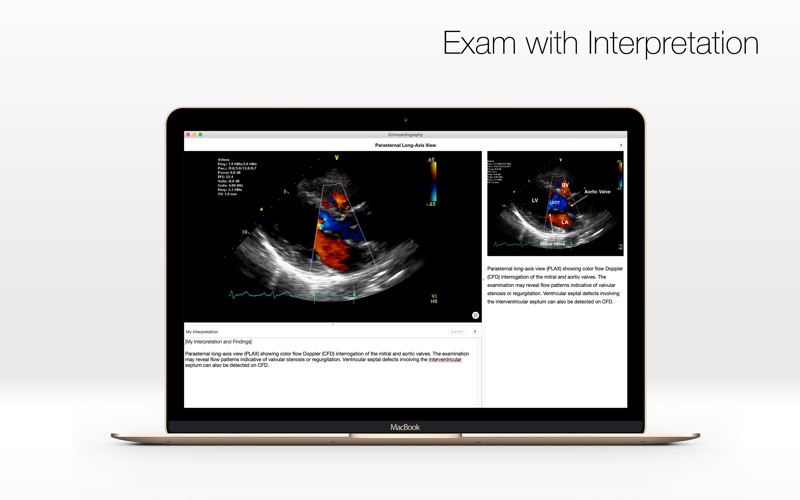
Turn your Mac to an Echocardiography Workstation, with over 200 real world echocardiography exams to review and learn. Get yourself ready before you do the job on real human's heart. Echocardiography, often referred to as a cardiac echo or simply an echo, is a sonogram of the heart. (It is not abbreviated as ECG, which lay persons often use as an abbreviation for an electrocardiogram.) Echocardiography uses standard two-dimensional, three-dimensional, and Doppler ultrasound to create images of the heart. Echocardiography has become routinely used in the diagnosis, management, and follow-up of patients with any suspected or known heart diseases. It is one of the most widely used diagnostic tests in cardiology. It can provide a wealth of helpful information, including the size and shape of the heart (internal chamber size quantification), pumping capacity, and the location and extent of any tissue damage. An Echocardiogram can also give physicians other estimates of heart function such as a calculation of the cardiac output, ejection fraction, and diastolic function (how well the heart relaxes). Echocardiography can help detect cardiomyopathies, such as hypertrophic cardiomyopathy, dilated cardiomyopathy, and many others. The use of Stress Echocardiography may also help determine whether any chest pain or associated symptoms are related to heart disease. The biggest advantage to echocardiography is that it is noninvasive (doesn't involve breaking the skin or entering body cavities) and has no known risks or side effects. Not only can an echocardiogram create ultrasound images of heart structures, but it can also produce accurate assessment of the blood flowing through the heart, using pulsed or continuous wave Doppler ultrasound. This allows assessment of both normal and abnormal blood flow through the heart. Color Doppler as well as spectral Doppler is used to visualize any abnormal communications between the left and right side of the heart, any leaking of blood through the valves (valvular regurgitation), and to estimate how well the valves open (or do not open in the case of valvular stenosis). Echocardiography was also the first ultrasound subspecialty to use intravenous contrast.